Architectural Documentation Services: From Blueprint to Build
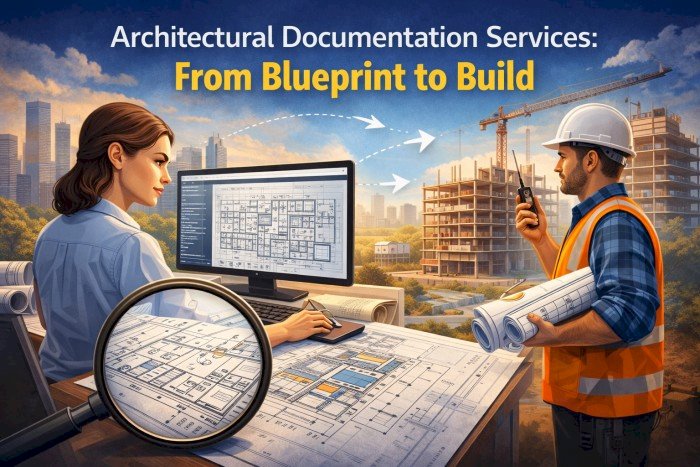
A single misplaced dimension on a construction drawing can cascade into thousands of dollars in rework, project delays, and strained client relationships. This is the reality architects, engineers, and contractors face every day—and it's exactly why architectural documentation services have become a cornerstone of successful project delivery.
This post breaks down what professional documentation looks like across the full project lifecycle, what components it should include, and how modern technology is raising the bar for precision and efficiency.
The Lifecycle of Architectural Documentation
Documentation doesn't begin when construction starts. It runs parallel to every phase of a project—from the first sketch on a napkin to the final as-built record.
Concept to Design Development
Early-stage documentation captures the vision. Schematic drawings, site analysis reports, and preliminary floor plans translate a client's brief into something tangible. This phase sets the trajectory for everything that follows. Errors introduced here don't stay small—they grow.
Construction Documentation
This is where the detail work happens. Construction documents are the legal and technical backbone of any build. They communicate exactly how a structure should be built, specifying materials, dimensions, systems, and finishes. Ambiguity here isn't just inconvenient—it's costly.
Post-Construction Records
Once a project is complete, as-built drawings document what was actually constructed versus what was originally designed. These records are critical for future renovations, maintenance, and compliance audits.
Why Professional Documentation Reduces Cost and Risk
Cutting corners on documentation is a false economy. Studies from the construction industry consistently show that errors and omissions in design documents are among the leading causes of project cost overruns. Professional architectural documentation services address this directly.
Error reduction is the most immediate benefit. When drawings are produced with precision, contractors spend less time seeking clarification and less money correcting mistakes in the field. Rework is expensive—both financially and in terms of schedule disruption.
Regulatory compliance is another critical factor. Building permits, zoning requirements, and safety codes aren't optional. Thorough documentation ensures that projects meet local authority requirements before construction begins, avoiding costly rejections or mandated changes mid-build.
Cost forecasting also improves significantly. Accurate documentation gives quantity surveyors and project managers the data they need to produce reliable cost estimates. Vague or incomplete drawings lead to inflated contingency budgets and surprise expenses.
Key Components of High-Quality Documentation
Not all documentation is created equal. Comprehensive architectural documentation covers several interconnected components, each serving a specific purpose.
Detailed Floor Plans
Floor plans are the foundation. They communicate spatial relationships, room dimensions, circulation paths, and structural elements. Well-drafted floor plans eliminate guesswork for every trade on site.
Site Analysis
Before a design can be finalized, the site must be thoroughly understood. Site analysis documents address topography, orientation, access points, drainage patterns, and neighboring structures. Skipping this step often results in costly redesigns once ground conditions are better understood.
Structural Diagrams
Structural documentation translates the engineer's calculations into buildable instructions. These drawings specify load-bearing walls, beam placements, foundation types, and connection details. They must align precisely with architectural drawings to prevent conflicts on site.
MEP Coordination
Mechanical, electrical, and plumbing systems need to be coordinated within the architectural framework. Clashes between a structural beam and a ductwork run, for example, are far cheaper to resolve on paper than in a ceiling cavity. MEP coordination drawings identify and resolve these conflicts before they reach the job site.
How Technology Is Transforming Documentation Accuracy
The shift from hand-drafted drawings to digital tools has fundamentally changed what's possible in architectural documentation services.
Building Information Modeling (BIM)
BIM goes beyond drawing. It creates a three-dimensional, data-rich model of a building where every element—walls, doors, windows, structural components, and building systems—is interconnected. When a wall moves in a BIM model, every affected drawing updates automatically. This reduces coordination errors dramatically.
BIM also enables clash detection, where software automatically identifies conflicts between different building systems before construction begins. The result is fewer surprises on site and a more predictable build process.
Firms like Archdraw Outsourcing leverage BIM to deliver documentation packages that are not only visually precise but technically coordinated across all disciplines. This level of integration is increasingly expected on commercial and large-scale residential projects.
CAD and its ongoing role
Computer-aided design (CAD) remains widely used, particularly for 2D drawing production. While BIM has taken over on complex projects, CAD continues to play a significant role in producing clear, standards-compliant construction documents. Its accessibility and versatility make it a practical choice across a broad range of project types.
Cloud Collaboration
Modern documentation workflows are also cloud-based, allowing architects, engineers, contractors, and clients to access the latest drawings in real time. Version control becomes manageable, and the risk of contractors working from outdated drawings—a surprisingly common cause of on-site errors—is significantly reduced.
Bridging Vision and Reality Through Documentation
The gap between what an architect imagines and what gets built is often a documentation problem. When drawings are vague, incomplete, or poorly coordinated, that gap widens. Builders make assumptions. Trades work around each other. The finished product drifts from the original design intent.
High-quality architectural documentation services close that gap. They give every party in the construction process a clear, shared understanding of what needs to be built, how it needs to be built, and what standards it needs to meet. The result isn't just a more accurate building—it's a smoother process, a more predictable budget, and a better client outcome.
For firms looking to elevate their documentation quality without stretching internal resources, outsourcing to specialists like Archdraw Outsourcing offers a practical path forward. Their teams bring technical expertise, familiarity with current standards, and the capacity to handle complex, high-volume documentation demands.
The bottom line: investing in rigorous documentation at every stage of a project isn't an overhead cost. It's one of the most effective risk management strategies available to anyone in the built environment.
What's Your Reaction?