Confused by Land Calculations? Here’s How Big Your Property Really Is
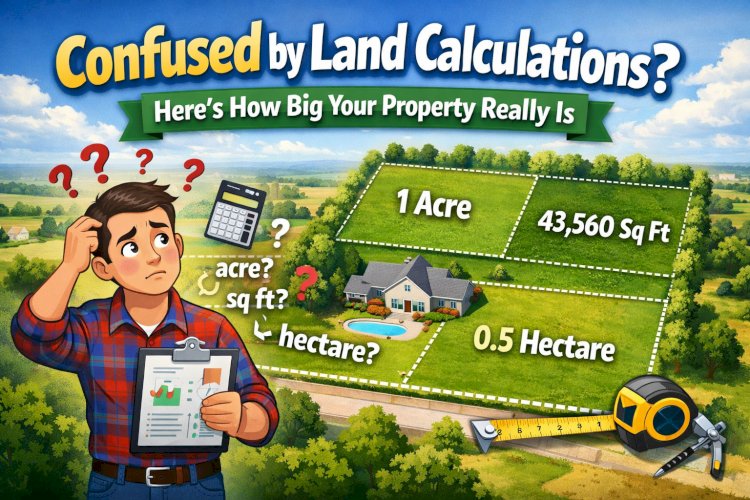
Buying land, selling property, or even inheriting a plot can quickly become confusing when numbers start flying around in unfamiliar units. One document mentions bigha, another talks about hectares, while online listings often use acres or square feet. If you have ever stared at land papers wondering how big your property actually is, you are not alone.
Land measurement units vary widely across regions, countries, and even states. Understanding how these units work—and how they relate to each other—can help you avoid costly mistakes, negotiate better deals, and make informed decisions. This guide breaks down common land measurement units, explains where they are used, and shows you how to interpret them correctly.
Why Land Measurement Units Cause So Much Confusion
Unlike standardized weights or distances, land measurement systems evolved regionally. Historical farming practices, colonial influences, and local administrative rules all played a role in shaping how land was measured. As a result:
-
The same unit name can mean different sizes in different regions
-
Official records may use one unit, while market listings use another
-
Conversions of Hectare to Bigha are often approximate, not exact
This inconsistency is especially common in countries like India, where traditional units such as bigha or kanal coexist with metric units like hectare and square meter. This is where conversions like hectare to bigha become practically important, as they help bridge the gap between traditional understanding and official measurements.
Understanding Bigha: A Traditional but Variable Unit
Bigha is one of the most commonly used land measurement units in North India. However, it does not have a fixed value nationwide. The size of one bigha depends entirely on the state or region.
For example:
-
In Uttar Pradesh, one bigha is roughly 2,500 square meters
-
In Rajasthan, it may range between 1,600 and 3,000 square meters
-
In West Bengal, bigha is typically much smaller
Because of this variation, relying on the term “bigha” alone without regional context can be misleading. Always confirm which state standard applies before calculating land size or value.
Hectare: The Globally Recognized Metric Standard
A hectare is part of the metric system and is widely used in official land records, agricultural planning, and international documentation. One hectare equals:
-
10,000 square meters
-
Approximately 2.47 acres
The advantage of using hectares is consistency. Unlike traditional units, a hectare has the same value everywhere in the world. This makes it easier for government agencies, investors, and planners to communicate land size clearly.
In many cases, landowners need to convert between regional units and metric units(Hectare to Bigha), especially when dealing with banks, legal paperwork, or development authorities.
Acre: Common in Real Estate and Global Listings
The acre is widely used in countries such as the United States, the UK, and in international real estate listings. In India, acres are often used in urban development projects and online property portals.
One acre equals:
-
4,046.86 square meters
-
0.4047 hectares
Because acres sit comfortably between local and global measurement systems, they are often used when marketing land to a broader audience. If you are comparing properties across regions or countries, acres can offer a useful reference point.
Square Feet and Square Meters: Precision at Smaller Scales
When it comes to residential plots, apartments, or small commercial properties, square feet and square meters are the most precise units.
-
Square feet are common in India, the US, and real estate brochures
-
Square meters are standard in metric-based documentation
These units are especially useful when calculating construction costs, floor area ratios, or carpet area. However, for large agricultural lands, they can feel impractical due to the large numbers involved.
Why Accurate Land Conversion Matters
Understanding land measurements is not just about curiosity—it has real financial and legal implications.
Incorrect conversions can lead to:
-
Overpaying or underselling land
-
Disputes during property registration
-
Errors in taxation or land-use classification
For farmers, a small miscalculation can affect subsidy eligibility or crop planning. For investors, it can distort return-on-investment estimates. Accurate conversions Hectare to Bigha help ensure transparency and protect your interests.
How to Calculate Your Actual Land Size
To know how big your property really is, follow these practical steps:
-
Identify the unit used in official records
Check land deeds, sale agreements, or revenue records to see which unit is mentioned. -
Confirm the regional definition
If the unit is traditional, such as bigha, find out the state-specific standard. -
Convert to a universal unit
Translate the measurement into square meters, hectares, or acres for clarity. -
Use reliable tools or expert advice
Online calculators are helpful, but for legal or financial decisions, consulting a professional is always safer.
Digital Tools and SEO: An Unexpected Parallel
Interestingly, land measurement confusion is similar to how people struggle with digital metrics. Just as land has multiple units, online performance is measured through impressions, clicks, rankings, and conversions. Without proper interpretation, numbers can be misleading.
This is why businesses often rely on experts who understand how to translate data into real-world value. Just as you would consult a land surveyor for accurate measurements, companies working online often seek guidance from specialists, such as the best San Diego SEO expert company, to interpret performance metrics correctly and turn them into measurable growth.
Long-Tail Keywords and Property Research
Modern property buyers often start their journey online, searching for phrases like:
-
how to calculate land size in bigha and acre
-
land measurement units used in India
-
convert agricultural land units accurately
Understanding these queries is useful not just for buyers, but also for developers, agents, and landowners who want to present clear and transparent information. Providing accurate measurement details builds trust and reduces friction during negotiations.
Common Mistakes to Avoid
Even experienced buyers make errors when dealing with land units. Some common mistakes include:
-
Assuming all bighas are the same size
-
Relying solely on verbal descriptions
-
Ignoring discrepancies between documents and on-site measurements
Avoiding these pitfalls starts with awareness and a willingness to double-check numbers.
Final Thoughts: Clarity Brings Confidence
Land is one of the most valuable assets a person can own, but its value depends heavily on understanding its true size. Whether you are dealing with bigha, hectare, acre, or square feet, clarity in measurement empowers you to make smarter decisions.
By learning how different units relate to each other and by verifying conversions carefully, you can remove confusion from the process. The result is greater confidence, smoother transactions, and a clearer picture of what you actually own.
When you truly understand how big your property is, land calculations stop being intimidating and start becoming a powerful tool in your decision-making process.
What's Your Reaction?