Step-by-Step Process of Public Limited Company Registration
Introduction
Starting a Public Limited Company (PLC) in India is a strategic choice for entrepreneurs and businesses aiming to raise capital from the public, enjoy limited liability, and build a reputable corporate structure. However, registering a Public Limited Company involves several legal, procedural, and compliance steps. This guide will take you through the step-by-step process of Public Limited Company Registration in India, ensuring you understand every detail before moving forward.
What is a Public Limited Company?
A Public Limited Company is a type of company that offers its shares to the public, either through private placements or by listing on the stock exchange. It is governed by the provisions of the Companies Act, 2013 and the rules set forth by the Ministry of Corporate Affairs (MCA).
Unlike a private limited company, a PLC has no restriction on the maximum number of shareholders, making it a popular choice for businesses seeking to raise funds on a large scale.
Key Features of a Public Limited Company:
- Minimum 7 members are required to form a PLC.
- At least 3 directors must be appointed.
- Shares are freely transferable.
- Mandatory statutory compliance and audits.
- Higher credibility and transparency compared to other business structures.
Benefits of Public Limited Company Registration
Registering as a Public Limited Company offers numerous advantages, including:
- Access to Capital – Ability to raise funds from the public through shares or debentures.
- Limited Liability – Shareholders are liable only up to the value of their shares.
- Brand Recognition – Public companies gain trust and credibility in the market.
- Growth Opportunities – Easier expansion due to wider capital base and public investments.
- Share Transferability – Easy transfer of shares helps in attracting investors.
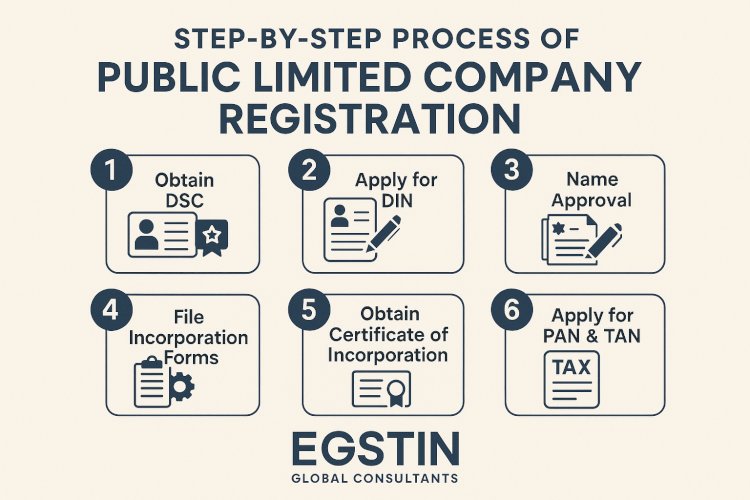
Step-by-Step Process of Public Limited Company Registration
The process of registering a Public Limited Company in India involves several stages, from documentation to final approval from the Registrar of Companies (ROC). Below is a detailed step-by-step breakdown.
Step 1: Obtain Digital Signature Certificate (DSC)
The first step for all directors and shareholders is to obtain a Digital Signature Certificate. Since company registration is completely online, a DSC is necessary for signing electronic forms on the MCA portal.
- Required documents for DSC:
- Passport-size photo
- PAN card
- Aadhaar card / Voter ID / Passport / Driving License
- Email ID and Mobile Number
Step 2: Apply for Director Identification Number (DIN)
Every proposed director of the company must have a DIN (Director Identification Number). DIN is a unique 8-digit number allotted by the MCA, which is mandatory for becoming a director in any company.
- DIN can be applied while filing the incorporation form (SPICe+).
Step 3: Name Approval of the Company
Choosing a unique and relevant name is crucial. The name must comply with the naming guidelines issued by the MCA and should not resemble existing company names or registered trademarks.
- Application for name approval is filed in Part A of SPICe+ form.
- You can propose two names at a time.
- Once approved, the name remains reserved for 20 days.
Step 4: Drafting the Memorandum of Association (MOA) & Articles of Association (AOA)
- Memorandum of Association (MOA): Defines the objectives, business scope, and powers of the company.
- Articles of Association (AOA): Outlines internal rules, management procedures, and regulations of the company.
These two documents form the charter documents of the company and must be filed with the MCA during registration.
Step 5: Filing SPICe+ Form (INC-32)
The incorporation of a Public Limited Company is done through the SPICe+ (Simplified Proforma for Incorporating Company Electronically Plus) form. This integrated form covers multiple services:
- DIN allotment
- Name approval
- Incorporation application
- PAN & TAN application
The form must be submitted along with the following attachments:
- MOA & AOA
- Address proof of registered office
- Identity and address proof of directors and subscribers
- Utility bill of registered office (not older than 2 months)
- NOC from the property owner (if office premises are rented)
Step 6: Verification & Approval by ROC
Once the application and documents are filed, the Registrar of Companies (ROC) reviews the submission. If everything is in order, the ROC issues the Certificate of Incorporation (COI).
This certificate contains the Company Identification Number (CIN), officially recognizing the company as a legal entity.
Step 7: Apply for PAN, TAN, and Bank Account
- PAN (Permanent Account Number) and TAN (Tax Deduction Account Number) are automatically generated with the incorporation process.
- After receiving the COI, the company must open a bank account in its name to carry out financial transactions.
Step 8: Compliances After Incorporation
After registration, the company must comply with post-incorporation requirements, such as:
- Appointment of Auditor within 30 days.
- Issuance of share certificates to subscribers.
- Filing commencement of business (INC-20A) with ROC.
- Conducting the first board meeting within 30 days.
- Maintaining statutory registers and records.
Documents Required for Public Limited Company Registration
Here’s a checklist of documents you’ll need:
- For Directors & Shareholders:
- PAN Card
- Aadhaar Card / Passport / Voter ID / Driving License
- Passport-size photographs
- Proof of residence (utility bill or bank statement)
- For Registered Office:
- Address proof (electricity bill, rent agreement, or property papers)
- NOC from property owner (if rented)
Cost of Public Limited Company Registration in India
The cost may vary depending on professional charges and government fees, but generally includes:
- Government filing fees
- DSC charges
- Professional fees (CA/CS/Consultant)
- Stamp duty (differs from state to state)
On average, the registration may cost between ₹7,000 – ₹25,000, depending on the number of directors, capital, and state stamp duty.
Why Choose EGSTIN Global Consultants for PLC Registration?
At EGSTIN Global Consultants, we simplify the complex process of Public Limited Company Registration. Our experts provide end-to-end assistance, including documentation, filing, compliance, and advisory support.
What We Offer:
- Quick and hassle-free online registration
- Expert legal and tax consultation
- Transparent pricing with no hidden charges
- Lifetime compliance support
- 100% customer satisfaction
Final Thoughts
Registering a Public Limited Company in India is a structured process that demands attention to detail and compliance with legal norms. From obtaining a DSC to filing the SPICe+ form and receiving the Certificate of Incorporation, each step is crucial to establishing a legally recognized entity.
If you are planning to expand your business and raise funds publicly, forming a PLC is a strategic move. With the guidance of professional consultants like EGSTIN Global Consultants, the process becomes seamless and error-free.
What's Your Reaction?